Geology
Tectonic framework
From a tectonic point of view, the area is part of the Carpathian Orogen. The Buila-Vânturariţa massif is part of the Getic canvas, a unit of the median Dacids in the Southern Carpathians, put in place in the Senonian, within the Laramic tectogenesis. The Getic cloth is made up of prealpine crystallophilic formations and a sedimentary blanket within which the oldest deposits are of superior coal-borne age. Due to the erosion, sedimentary deposits of the Getic cloth are found only in a few areas, the most important of which are Braşov-Dâmbovicioara, Buila-Vânturariţa, Haţeg and Resita-Moldova Noua. These sedimentary deposits were subjected to tectonogenetic processes in two phases. The first significant discordance is pre-Albian, when the Getic sariage began and corresponds to the first Getic phase, the age of the first mount being placed after the Lower Aptian and before the end of the Upper Aptian. The second Getic phase, representing the main Laramic sariage, took place in the Senonian, when the Getic cloth, based on the Severin cloth, covered the Danubian domain.
Stratigraphy
In the area of the Buila-Vânturariţa massif, there is a succession of metamorphic and sedimentary deposits that can be traced entirely on the openings offered by the valleys of the four rivers that cross the calcareous bar, digging into it a sector of gorges.
Crystalline formations
In the Buila-Vânturariţa massif, the metamorphic rocks outcrop on the northwest slopes, on the river valleys Bistriţa, Costeşti, Cheia and Olăneşti, as well as in the ridge area, where they come to date from under the sedimentary deposits eroded (Curmătura Builei). The metamorphic evolution of the Gneissic units in the Getic Cloth is part of the time interval of the Varisc cycle (300 – 350 m.a). The evolution of the metamorphites in the Southern Carpathians currently has clearer landmarks, emphasizing the polystadial character and a distinct evolution of the Getic-Supragetic vs. Danubian, in a sequence of events from subduction to obduction and a tectonic inversion in the middle and upper Cretaceous. The metamorphic rocks in the Getic-Supragetic domain can be divided into two main types of lithologies: a type dominated by crystalline limestones, amphibolites, micaschists, paragneisse, quartzites, which lack migmatites, representing Negoi metalitofacies, and the second is relatively poor in carbonate and amphibolitic rocks, being dominated by gneisse and migmatite, representing the Metalitofacies of Sebeş-Lotru, within the latter also including the crystalline formations from the Buila-Vânturariţa massif.
sedimentary formations
After the completion of the Baikalian cycle, which generated epimetamorphic crystalline schists, the Getic domain evolved as an exundized area subject to denudation. It became an area of accumulation in neo-carboniferous, when predominantly continental deposits were accumulated. In the alpine cycle, the sedimentation process begins after the exoneration phase that lasted even during the Triassic. In the Jurassic, a series of depression areas are taking shape, including Buila-Vânturariţa. The Getic domain is again exonded after the Mesocretaceous tectogenesis. After this moment, a transgression takes place at the Cenomanian level, but the sedimentary formations are, for the most part, removed by erosion.
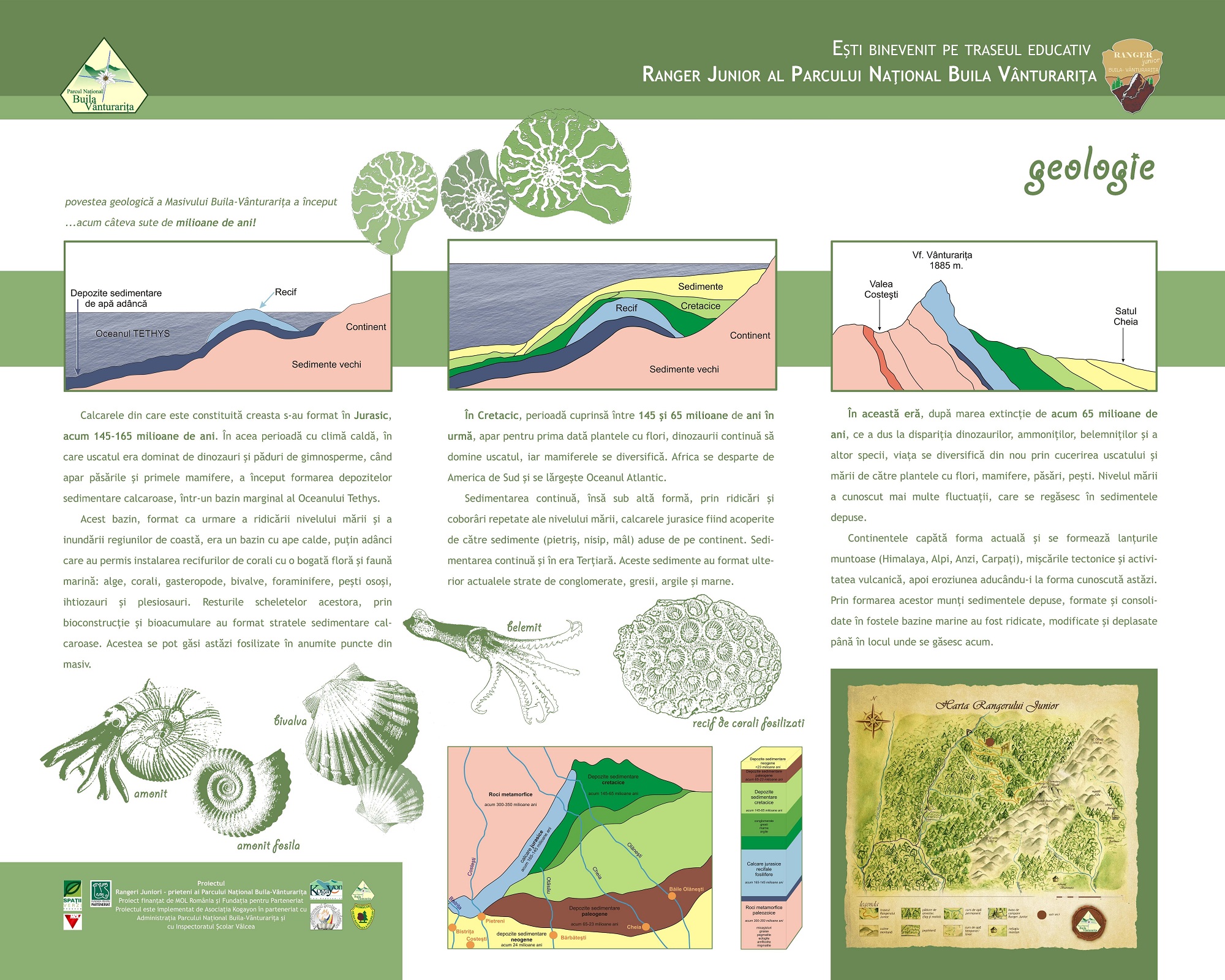
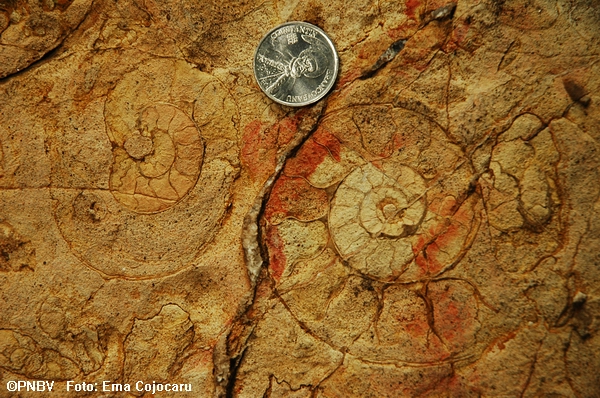
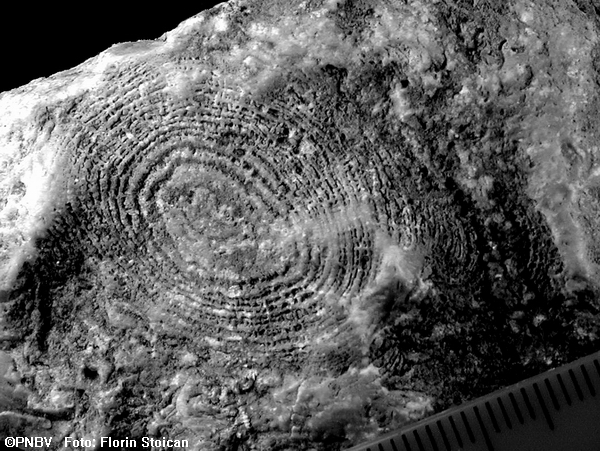
In the area of the Buila-Vânturariţa Massif, the sedimentary sequence includes the lower Jurassic and Cretaceous deposits:
Lower Bajocian-Barkhonian: coarse sandstones and massive, spatic, coral-like limestones.
Upper Bathonian-Lower Callovian: calcareous sandstones and limonite limestones with greenish and red spots, with elements of micaschists.
Middle-upper Callovian: shale, calcareous, yellowish-reddish sandstones, microconglomerates and yellowish micaceous limestones.
Oxfordian: marly shale, marl calcareous, red limestone with jaspers.
Lower Kimmeridgian: fine red, layered limestones.
Superior Kimmeridgian-Tithonian: 250-300 m Massive reef limestones.
Tithonian Superior-Berriasian: Missing.
VALANGINIAN: oosparite, pelsparite, intrapelsparite, which pass laterally and successively to biomycrites.
HAUTERIVIAN: Missing.
Barhemian-Aptian: Urgonian facies that is arranged transgressively and discordantly over the Neoconian formations. The Cretaceous formations represent a very well-developed detrital series (maximum 10,000 m, with thicknesses increasing from the southwest to northeast):
Lower Albian-Vraconian: the lower horizon of sandstones and conglomerates.
Vraconian-Turonian-Coniacian: the lower marl-clay horizon with alternations of clays and marls, sometimes thin sandstones.
Santonian-Lower Campanian: the upper horizon of sandstones and conglomerates.
Superior-Maastrichtian Campania: the upper marl-clay horizon.