Pedology
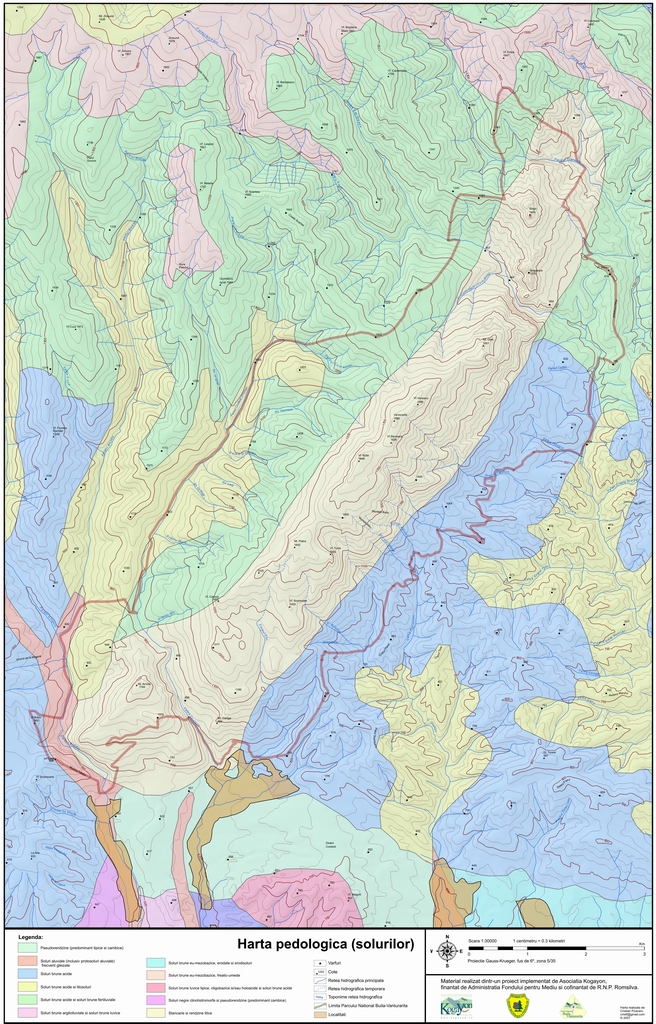
The soils in the Buila-Vânturariţa massif, being mostly formed on a calcareous substrate, do not present a great diversification, being different only because of the type of plant associations that were formed on them.
Overall, between the soils of the predominant Buila-Vânturariţa National Park are the redzines due to the calcareous configuration of the massif.
On the beech floor, humic-ferriiluvial, acid brown podzolic soils of alpine and forest meadows, with an acidic reaction and different degrees of podzolization, can be found.
In the floor of the conifers, there are podzolic, brown acid and ferriiluvial podzolic soils.
In the cracks of the rocks there is turbosy soil on which species with special adaptations – hasmophytes have settled.
Alluvial soils are found along the valleys.
Map made within the project of the Kogayon Association “Implementation of the Natura 2000 European Ecological Network on the territory of the Buila-Vânturariţa National Park and the realization of the Park Management Plan” financed by the Administration of the Fund for the Environment and co-financed by RNP Romsilva
–>