
monuments

On the territory of the Geopark there are over 50 historical monuments + more than 10 others in the immediately neighboring localities:

7 monasteries – Hurezi (UNESCO heritage, 18th century), Bistrița (15th century), Arnota (18th century), Pătrunsa (18th century), Sărăcinești (18th century), Frăsinei (19th century), Govora (16th century). All are monastic ensembles, with several historical monument buildings
7 hermitages – Pahomie (17th century), Iezer (17th century), gutters (17th century), Bradu (18th century), Comanca (18th century), Saint Stephen (18th century), Saints Apostles (18th century). XVIII)
Two cave churches in Bistrița, in the Bat Cave – Ovidenia (17th century) and the Holy Archangels (18th century)
7 wooden churches – Marița (16th century), Cornet (19th century), Grămești (17th century), Grușetu (19th century), Popești-Cacova (18th century), Church of Horea from Albac (17th century), Wooden church from Pietrari (18th century).
Two cules at Măldărești – Cula Greceanu (18th century) and Cula Duca (19th century)
24 churches of the former hermitages and parishes – Sfântul Ioan Vaideeni (19th century), Horezu (18th century), Romanians (18th century), Urșani (18th century), Râmești (18th century), Covrești (18th century), Păpușa (18th century), Peri (18th century), 44 sources (18th century), Ciorobești (18th century), wintery (18th century), Măleni (18th century), Vătășești (18th century), Mierlești (18th century), Poieni (18th century), Drăgănești (18th century), Neghinești (18th century), Sfinții Voievozi Cheia (18th century), Olănești Coast Church (18th century), Valea din Case Church Olănești (18th century), Chiciora Păușești (18th century), Climent Pietrari Hermitage (18th century), Măldărești Church (18th century), Slătioara Church (18th century).
Local architecture in Pietreni, Bărbăți, Dobriceni, Bistrița, Costești

Bistriţa - Costesti Monastery

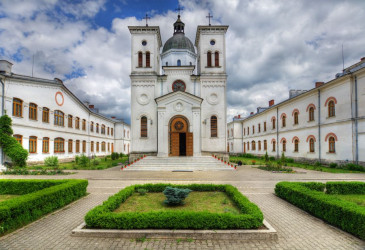
A foundation of the Craiovesti boyars, Banul Barbu and his brothers Pârvu, Danciu and Radu, the Bistriţa Monastery dates from around 1490. The current church is built in neo-Gothic style, with generous dimensions, having the appearance of a cathedral. It has a large, cylindrical spire on the nave, and two smaller ones, parallelepiped on the pronaos, an apse flanked by two lateral apses and two triangular pediments on the sides. The interior impresses with its size, and the eye accustomed to the Byzantine style is opposed by the Gothic-style pediment, executed in Vienna. The painting of the new church, in oil, was executed by the painter Gheorghe Tătărescu in 1850, a realistic, monumental painting with wide registers. The painting is modern, at the entrance are the mural portraits of Barbu Craiovescu and the ruling prince from 1855, Barbu Ştirbei. Inside is also the tomb of the founder.

Among the valuable decorative elements in the interior, the six-faced icon, painted by a monk in 1833, representing Jesus Christ, Saint Mary and Saint John, stand out, and on the other side the Holy Martyrs Basil, Gregory and John, through the ingenious arrangement of some blades perpendicular to the main faces of the icon.

Also inside are the relics of Saint Gregory the Decapolitan (a saint who lived in Asia Minor around 780 AD), brought here by Barbu Craiovescu, shortly after the foundation, sheltered by a beautiful silver reliquary, Richly ornamented, given to the monastery by Mrs. Bălaşa, the wife of ruler Constantin Şerban-Vodă, in 1656.
 

Bolniţa Church - Bistriţa

From the foundation of Craiovesti, today only the little church (1520-1521), a modest construction (11 x 4 m), made of stone (river boulders) and in some places brick, Ship, without a spire, covered with slats. The church has a square nave, with a rounded altar inside, without a pronaos. The vault is cylindrical in shape and without a spire (index of great antiquity like Cotmeana).

The church has an impressive interior fresco, made by Dumitru Chirtop around 1520, being the second oldest in Oltenia after the one at the Cozia Monastery (1388), from the late Paleologous tradition, when they began to penetrate the Balkans Artistic elements used by Cretan iconographers. The Church is dedicated to the “Face of the Transfiguration”. Later, the nobleman Şerban Cantacuzino (his portrait is painted to the left of the door, together with that of his lady Adriana) added an open, masonry porch on stone pillars, painted by Joseph The hieromonk and Harinte, in the Brancove style (1710).

In the immediate vicinity of the church, you can also see:

  • The house of the hospital – built by Archimandrite Gavriil Petrovici in 1836, its spaces knowing different uses: hospital, school, abbot, residence (house of priests) and forced residence of Ion Antonescu.
  • Dăscăliţei’s vault – built of brick by the architect Nae Panait, housing the bones of Maria Dumitraşcu, the first teacher of the orphanage.
  • The tomb of Bishop Vartolomeu Stănescu – monumental building in Byzantine style, dating back to 1933.
  • Bishop Vartolomeu’s villa – built in 1933 by the same bishop, standing out for his authentic Romanian style, with open porches, with semicircular arches, placed on carved and painted wooden pillars.
  • A few specimens of secular edible chestnuts (Castanea sativa), in the garden in the west of the monastery.
  • Bibescu Vodă Bridge, located at the exit of Bistriţa from Chei, built between 1846-1848.
  • The monumental crosses dug into the right wall of the Bistriţa gorges, at its exit from the limestone walls, dating back to the reign of Charles I (probably 1867, following his visit).
 

Ovidenia Church - Bat Cave (Saint Gregory the Decapolitan) – Bistriţa

The oldest historical monument in the Bat Cave is the Ovidenia Church. It is assumed that the first church in the cave was built at the end of the 13th century, which was ruined in the 14th century, when the monks left the cave and built the Bolniţa Church, during the time of the abbot of Tismana.

The Ovidenia Church was founded between 1633-1635, but the latest research established that it was built at the same time as the relics of Saint Gregory the Decapolitan were brought to the Bistriţa Monastery, in 1497. The founder The church is considered to be the abbot Macarie, whose votive portrait is on the northern wall, next to that of the abbot Daniil, the last of the restorers (1828, according to others in 1609 and 1769). Subsequent restorations were made in 1944-1945 and 1977-1978.

The church was built both to serve as a place of worship, but especially to be the “mystery” of the monastery. Here, repeatedly, the relics of Saint Gregory the Decapolitan, the smells of the monastery and even the valuables of the rulers of those times, when the country was in danger, were hidden. For this purpose, a niche was built between the wall of the cave gallery and the western wall of the church, whose entrance was through the altar, and which was built and masked after the valuables were hidden there. This hiding place is due to the preservation of numerous valuable books and other art objects that today’s museums are proud of.

The church is built at the end of a small diverticulum that detaches from the main gallery of the cave, in a hidden place, being difficult to notice, and is built partly of brick wall, partially carved into the walls of the gallery.

Due to the conformation of the gallery, it does not respect the specifics of the Orthodox churches, having the altar facing the northwest. It consists only of a nave of modest dimensions (3 x 2.20 m) and an altar, and in the side walls were cut out the windows that simulate the windows.

The painting, executed in the Byzantine style, is quite poorly preserved, both because of the moisture in the cave and the tourists who left their “traces” on the walls of the church. Considering the year of the foundation, it can be assumed that it was the work of the same craftsmen painters who also painted the Bolniţa Church (Dobromir and the disciples Dumitru and Chirtop).


Păpuşa Hermitage - Bistriţa

The church was built in 1712, founded by the Bistri monks who were headed by the abbot Ştefan. They dedicated it to Saint Gregory the Decapolitan. The painting from the same era was made at the expense of some members of the Brâncoveanu family.

At the beginning, there were numerous cells here where the scholarly monks from the Bistriţa Monastery retreated quietly, but today only the church, located next to the village cemetery, has been preserved from the old hermitage (it still serves as a parish church of the village today). Bistrita).
The construction plan is rectangular (9.5 x 4.5 m on the outside), with the porch withdrawn about 70 cm from the nave wall. It consists of a porch, nave and altar. The porch is made up of six columns and two cylindrical semi-columns, with semicircle arches. On the nave there is a spire, in an octagonal plane, with a high parallelepiped base. As decorative elements, on the outside there are apparent brick belts, which surround the church next to the eaves, the base and the upper part of the spire.

The painting of the church dates from 1712, being the work of the painter Iosif and the hieromonk Teodosie.


Arnota Monastery – Bistriţa

It was founded by Matei Basarab in the years 1633-1634, dedicated to “Saints Archangels Michael and Gabriel”, on the foundation of an older church. The porch with the spire was added to him by Constantin Brâncoveanu, at the beginning of his reign, together with the repairs, in the years 1705-1706. He also reconstructs his catapeteasma, a true work of sculptural art, in Brancove style (since 1913 he has been at the Brâncoveneasque Art Museum in Mogoşoaia) and renovates the painting, without to replace the original one.

The monastery church is a small building, with a simple and sober line, being built according to a trilobed plan, with polygonal apses and an open porch. A high spire is placed above the nave, and on the porch there is another smaller spire, the one from Brâncoveanu’s time. The facades were divided, with the help of a belt of apparent brick, into two registers: the lower one, in which beautiful rounded threads can be observed, and the upper one, in which deep holes have been made. The walls and towers are embellished with apparent brick ornaments. The renovation of the church was done between 1852-1856, by the ruler Barbu Ştirbei, who demolished the old cells from the time of Matei Basarab, already ruined, and built other buildings, according to the plan of some foreign architects.

In the pronaos of the current church there are two tombs: the tomb of Matei Basarab, who died on April 9, 1654, first buried in Târgovişte and then brought to Arnota, after the Seimeni Uprising, and the Tomb of Danciu Vel-Vornic, the father of Matei Basarab, former soldier of Mihai Viteazul, who fell during the battles in Transylvania at Turda, buried in 1604 in Alba-Iulia, his mortal remains being brought to Arnota in 1648.

This beautiful monastery, through its painting, architecture and sculpture, can be considered one of the most representative historical and religious art monuments in the country.


Hermitage 44 Izvoare - Pietreni

Also known as the hermitage under the stone, the hermitage was built by the abbot Ştefan of the Bistriţa monastery, in 1701, being the metoc of this monastery.

From the old hermitage, only the church and an enclosure wall were preserved.

It is a simple church, in the shape of a nave, with a closed porch (later), nave and altar, with the exterior ornamentation of some apparent brick belts and a pediment with the icon of Saint Stephen. It is covered with slats, the four-pitched roof being of a very elegant slenderness.

The painting is the work of the painter Efrem Zugravul, unfortunately damaged as a result of the cracking of the walls, as a result of the shaking caused by the explosions in the nearby quarry.


Arnota Monastery – Bistriţa

It was founded by Matei Basarab in the years 1633-1634, dedicated to “Saints Archangels Michael and Gabriel”, on the foundation of an older church. The porch with the spire was added to him by Constantin Brâncoveanu, at the beginning of his reign, together with the repairs, in the years 1705-1706. He also reconstructs his catapeteasma, a true work of sculptural art, in Brancove style (since 1913 he has been at the Brâncoveneasque Art Museum in Mogoşoaia) and renovates the painting, without to replace the original one.

The monastery church is a small building, with a simple and sober line, being built according to a trilobed plan, with polygonal apses and an open porch. A high spire is placed above the nave, and on the porch there is another smaller spire, the one from Brâncoveanu’s time. The facades were divided, with the help of a belt of apparent brick, into two registers: the lower one, in which beautiful rounded threads can be observed, and the upper one, in which deep holes have been made. The walls and towers are embellished with apparent brick ornaments. The renovation of the church was done between 1852-1856, by the ruler Barbu Ştirbei, who demolished the old cells from the time of Matei Basarab, already ruined, and built other buildings, according to the plan of some foreign architects.

In the pronaos of the current church there are two tombs: the tomb of Matei Basarab, who died on April 9, 1654, first buried in Târgovişte and then brought to Arnota, after the Seimeni Uprising, and the Tomb of Danciu Vel-Vornic, the father of Matei Basarab, former soldier of Mihai Viteazul, who fell during the battles in Transylvania at Turda, buried in 1604 in Alba-Iulia, his mortal remains being brought to Arnota in 1648.

This beautiful monastery, through its painting, architecture and sculpture, can be considered one of the most representative historical and religious art monuments in the country.

Hermitage 44 Izvoare - Pietreni

Also known as the hermitage under the stone, the hermitage was built by the abbot Ştefan of the Bistriţa monastery, in 1701, being the metoc of this monastery.

From the old hermitage, only the church and an enclosure wall were preserved.

It is a simple church, in the shape of a nave, with a closed porch (later), nave and altar, with the exterior ornamentation of some apparent brick belts and a pediment with the icon of Saint Stephen. It is covered with slats, the four-pitched roof being of a very elegant slenderness.

The painting is the work of the painter Efrem Zugravul, unfortunately damaged as a result of the cracking of the walls, as a result of the shaking caused by the explosions in the nearby quarry.

Pătrunsa Monastery - Male

The hermitage is dedicated to “Cuvioasa Paraschiva”, from the name of the mother of Bishop Climent. This hermitage was built in 1740 by Bishop Climent of Râmnic, in memory of the fact that he was born here by his mother Paraschiva Modoran from Pietrarii de Jos, fugitive over the mountain for fear of a Turkish invasion, sheltering at the foothills Mount Buila, in the place called today Pătrunsa. The hermitage was destroyed following the fall of a rock, being rebuilt, in the second half of the 18th century, by the postman Dumitru, Protopopul Pietraru and the postman Ion Bărbătescu, probably descendants of Bishop Climent. The current construction dates from the 19th century, and the painting is in the Brancove style with popular influences (see St. Dumitru, St. George painted above the entrance to the outer porch). The church underwent changes in 1963 and 1977, when the abbot’s house was built during the time of the abbots Veniamin Grigorescu (1935-1975) and Paul Niculescu 1975-1990, when the porch was closed and the church being covered with tin. In 2006, a new church was founded.